
How to Find Your Property Pins Before Building a Fence in Conway, AR
If you’re planning a fence at your home in Conway or anywhere in Central Arkansas, there’s one step that has to happen before a single post goes in the ground: knowing where your property lines are.
Here’s something a lot of homeowners don’t realize. It’s actually your responsibility as the property owner to know where your property lines fall. Not the fence company’s. Not the city’s. Yours.
The good news is, it doesn’t have to be complicated. If you’re unsure where your property lines are, here’s the path we’d recommend walking through.
Step 1: Locate Your Survey or Plot Plan
The first place to start is the paperwork you already have. When you bought your home, you most likely received a survey or plot plan in your closing documents. It’s typically a one-page drawing showing the dimensions of your lot, the footprint of your house, and the location of the corner pins.
If you can’t find it, check with:
- Your closing attorney or title company
- Your mortgage lender (they usually keep a copy)
- Your county assessor’s office or local GIS website (most Central Arkansas counties have plot maps online)
That document is your starting point for everything else.
Step 2: Use the Survey to Check Where Pins Should Be
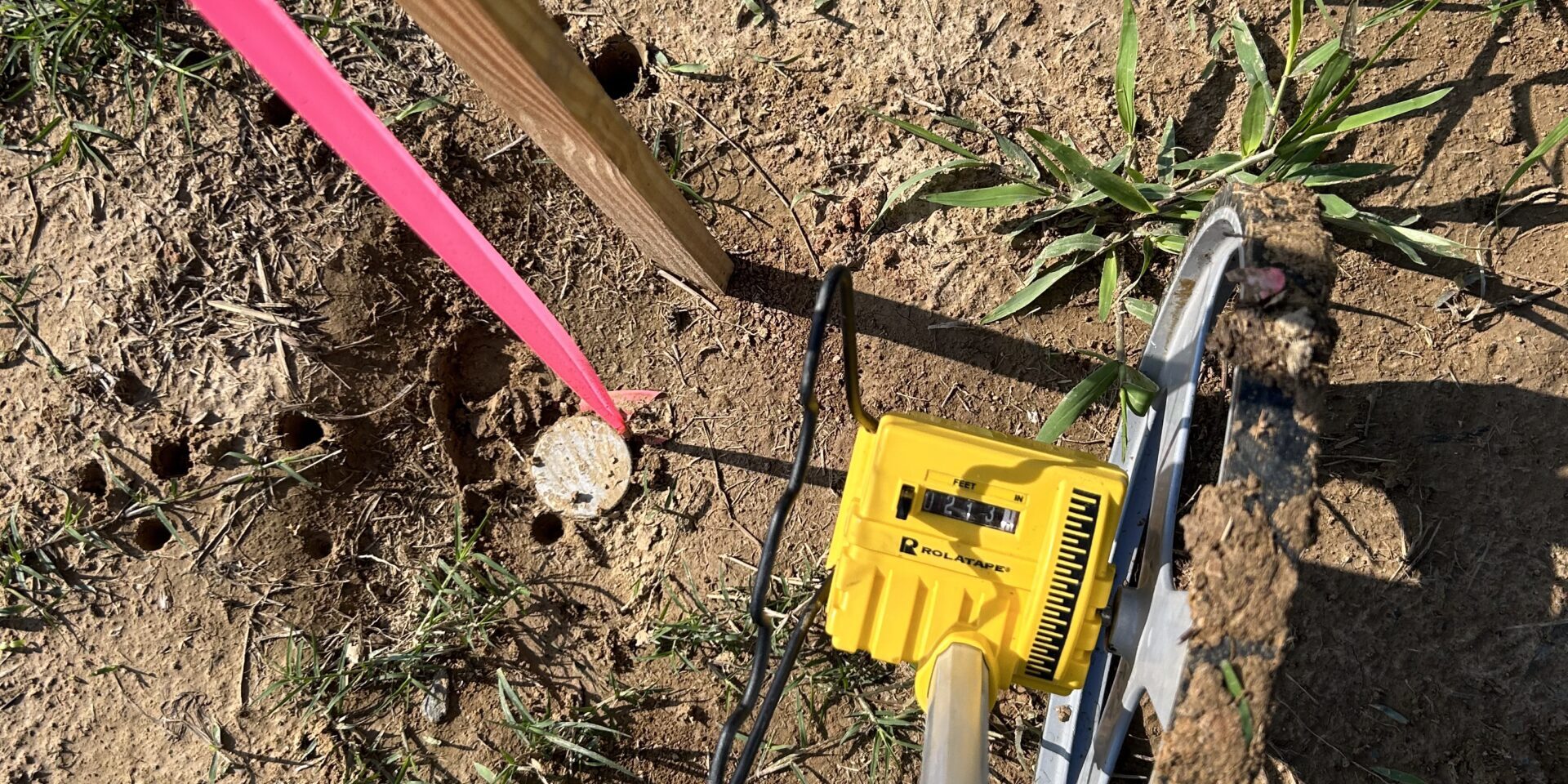
Once you have your plot plan, you can start checking the actual ground for pins. Property pins are small metal stakes driven into the ground at each corner of your lot. Most of the time they have a yellow or colored cap on top stamped with the surveyor’s information.
A few things worth knowing:
- The cap is just a marker. The pin underneath marks the actual property corner.
- Pink ribbon means survey. If you see pink flagging tied to a stake or tree near a corner, that’s surveyor code for “the pin is around here somewhere.”
- Pins get buried. In newer subdivisions especially, once topsoil and sod go in, those pins disappear under a couple inches of dirt. They’re still there. You just can’t see them.
- Construction crews knock them over. It happens. Pins can end up sideways or shifted from where they should be.
A good rule of thumb for the front of your property: the front pins are typically set somewhere between 10½ and 12 feet back from the back of the curb. That’s not exact. It varies by subdivision and how the lot was platted. But it gives you a search zone if you want to scout ahead of time.
Step 3: Talk to Your Fence Professional
Once you’ve done what you can on your own, the next step is to bring your fence professional into the conversation. A good fence contractor has experience finding pins, reading plot plans, and knowing where to look on different types of lots.
Depending on the project and the situation, your fence pro may be able to help locate pins or confirm whether your existing markers line up with your plot plan. They can also give you a straight answer about whether the lines look clear enough to build to or whether something looks off.
This is also the right time to talk through how your fence will be set relative to the line. We typically recommend setting the fence 2 to 4 inches inside your property line. That gives you room to maintain both sides without stepping onto your neighbor’s property, and it’s something a lot of fence contractors skip.
Step 4: Decide Whether You Need a Surveyor
After working through your survey and talking with your fence professional, you’ll have a much clearer picture of where things stand. From there, it usually comes down to one of three outcomes:
- Pins are visible or easily locatable. You’re good to move forward.
- Pins are buried but findable. With some scouting and the right tools, they can be uncovered and confirmed against your plot plan.
- Pins are missing, moved, or can’t be found. This is where a licensed surveyor comes in.
If you land in that third bucket, don’t try to guess your way through it. A licensed surveyor will either come find your existing corners and re-mark them, or do a full boundary survey and set fresh pins in the correct locations. It typically costs a few hundred dollars depending on the lot.
Here’s why that matters: if your fence ends up encroaching on a neighbor’s property, you’re the one who has to move it. That’s a much more expensive mistake than paying a surveyor up front.
What Bradford Recommends
Here’s the short version of how we’d suggest a homeowner approach this:
- Find your closing survey or plot plan first. That document does most of the heavy lifting.
- Do a visual scout of your lot using the dimensions on your survey.
- Check the rule of thumb on front pins. 10½ to 12 feet back from the curb is a solid starting zone.
- Loop in your fence professional before any work gets contracted. Make sure they’ve seen the survey and walked the lines with you.
- If anything is unclear, get a surveyor. Don’t guess. Don’t split the difference with your neighbor. Get the line professionally marked.
- Build a few inches inside the line. That buffer keeps maintenance simple and protects everyone long-term.
A little time spent up front on property lines saves a lot of headaches down the road.
A Quick Word on Neighbors
If you and your neighbor are sharing a fence line, a five-minute conversation before any work starts goes a long way. Show them where the pins are. Show them where the fence will go. It’s a small step that prevents most of the disputes we’ve seen over the years.
Have questions about property lines or planning a fence in Conway or the Central Arkansas area? Call or text us at 501-205-4345. We’re happy to walk through it with you. We have served hundreds of homeowners in Conway, Cabot, Greenbrier, Little Rock, Maumelle, and the surrounding area.
